
Main contents start here
CHAPTER 22 FAMILY INCOME AND EXPENDITURE
This chapter presents statistics on the income and expenditure of households, savings and liabilities, consumer durables, etc. Data are obtained from "Family Income and Expenditure Survey" and "National Survey of Family Income and Expenditure" by the Statistics Bureau, Ministry of Internal Affairs and Communications and "Consumer Confidence Survey" by the Economic and Social Research Institute, Cabinet Office.
Family Income and Expenditure Survey (Fundamental Statistical Survey)
The Family Income and Expenditure Survey, which originated from the Consumer Price Survey in July 1946, is conducted to obtain basic information needed for the formulation and evaluation of social and economic policies of the government by investigating people's income, expenditure, savings and debts. At the beginning, the Consumer Price Survey investigated prices, amount and expenditures of daily purchase by non-agricultural two-or -more-person-households living in cities. In September 1950, household income was included as a survey item, and the name of the survey was changed to "Family Expenditure Survey" in November 1951, and to the present name "Family Income and Expenditure Survey" in April 1953. The survey in Okinawa was started in July 1972, and integrated into the country results in 1973. In July 1999, agricultural households were included in the universe, and the results for the all households including agricultural households are compiled as well as the existing results for non-agricultural households in January 2000. In January 2002, the Income and Expenditure Survey for One-person Households, which clarified the income and expenditures of one-person households, and the Family Savings Survey, which clarified savings and debts of households, were consolidated into the Family Income and Expenditure Survey.
The sample size was originally 4,200 households living in 28 major cities. It was extended to 8,000 households in 170 municipalities in July 1962, to 8,000 households in 168 municipalities in January 1978, and to 9,000 households including single-person-households (except students) in January 2002. The survey is conducted every month on 9,000 households, but for each sample household, for six consecutive months in the case of two-or-more-person households, and for three consecutive months in case of one-person households, and then the sample households are rotated.
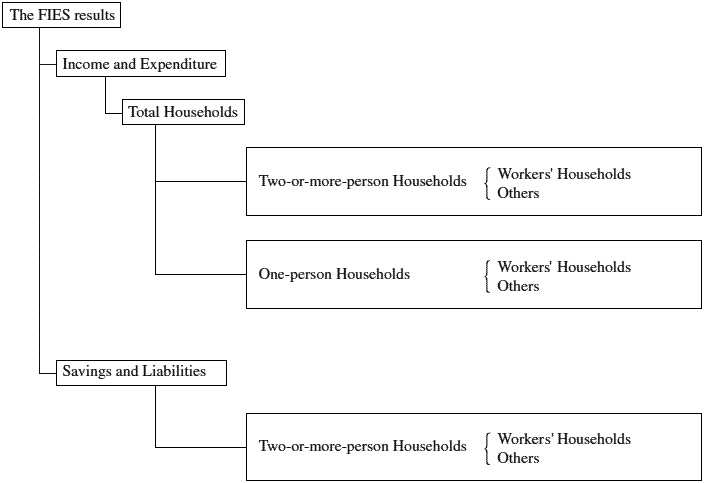
The results of the Survey are divided into the volume of income and expenditure and the volume of savings and liabilities. The volume of income and expenditure is further divided into the part for two-or-more-person households, for one-person households and for all households. Regarding two-or-more-person households, two historical series were available. One series, which goes back to 1963, is for households except for agriculture, forestry and fisheries households, and the other series, which goes back to 2000, is for households including agriculture, forestry and fisheries households. The former series, however, was abolished in 2008. The result for "total households" is the consolidated average of one-person households and two-or-more-person households.
Index of Consumption Expenditure Level
The index of consumption expenditure level is an index of adjusted consumption that is free from the effects of difference in the household size, number of days of the month, and changes in price levels. It is intended to show the trends of living standard in real terms of consumption expenditure.
The index is computed as follows. Firstly, weighted average of monthly consumption expenditure of each household size (number of household members) is calculated, with the household distribution in terms of size as the weights. Then, number of days of the month is adjusted to 30.4 days (365 days of a year divided by 12 months), and then the adjusted monthly consumption expenditure is converted into an index with the base year of 2010, and finally deflated by the consumer price index.
National Survey of Family Income and Expenditure (Fundamental Statistical Survey)
This survey aims to clarify the level, structure and distribution of household economies and their regional differences with respect to the expenditure, income and assets, by surveying receipts and disbursements, savings and debts and possession of durable goods, houses and housing lots of households. The survey has been conducted every five years since 1959, and the eleventh survey was taken in 2009.
The sample of the 2009 survey was 52,404 households with two or more members and 4,402 one-person households. Households with two or more members were surveyed for the period of three months from September to November 2009, and one-person households, for the period of two months from October to November, through the channel of the Statistics Bureau, Minister for Internal Affairs and Communications; prefectures; shi (cities), machi (towns) and mura (villages); supervisors; enumerators; and households.
Consumer Confidence Survey
The objective of this survey is to grasp promptly changes in consumer behaviour, possession and purchase of consumer durables, purchase of dwellings, etc. so as to provide basic data for judging business trends. It was started in September 1957 and has been conducted as a monthly survey. In fiscal 2004, the Monthly Consumption Trend Survey and the Survey on Current Consumption of One-person Households were consolidated and have been conducted monthly by the Economic and Social Research Institute, Cabinet Office.
The survey covers all the households in Japan except for foreigners, students and institutional households; 5,712 two-or-more person households and 2,688 one-person households are actually surveyed.

