Main contents start here
CHAPTER 17 ENVIRONMENT
This chapter contains statistics on greenhouse gases, atmospheric pollution, waste disposal, public hazards, water and sewage, and the ecosystems. The main sources of data are "Survey on Discharge and Disposal of Industrial Waste" and "Survey on Disposal of General Waste" by the Ministry of the Environment and "Survey on Complaints against Environmental Pollution" by the Environmental Dispute Coordination Commission.
Environment
At present, the United Nations and the Organisation for Economic Co-operation and Development (OECD), among others, are developing environmental indicators. The "PSR framework", which is proposed by OECD, is widely used by other international organisations and countries as the basis for developing their environmental indicators. The same framework is also used by the Comprehensive Environment Policy Bureau, Ministry of the Environment of Japan, for compiling "Environmental Statistics".
"PSR framework" of the Organisation for Economic Co-operation and Development (OECD)
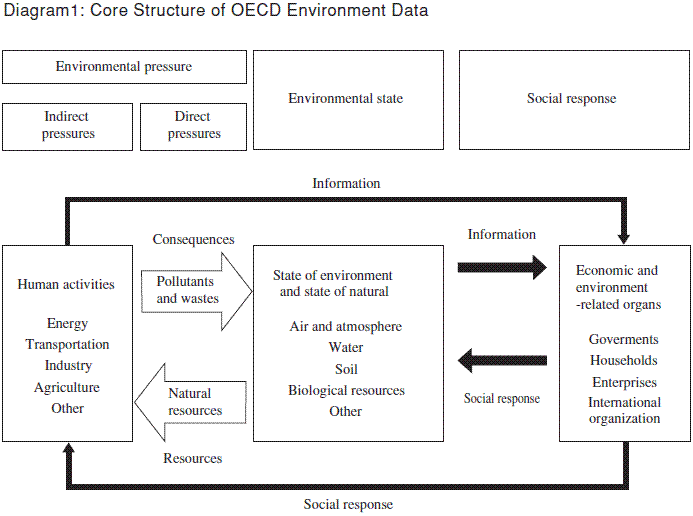
OECD has developed the "PSR framework" to be used as a conceptual scheme to arrange the environmental information and put it together into indicators. The framework is aimed at grasping the relationship between human activities and the environment through a flow of processes, PSR, namely, "Pressure on environment", "State of environment as a consequence" and "Social responses for it". And the environmental indicators of OECD, which are based on this PSR model, use the "core set" as the basic tool to comprehend the structure of environmental problems (see Diagram 1). The elements of the "PSR framework" are as follows.
- <1> Pressure on environment
-
The indicators to measure the environmental pressure represent the pressure of human activities on the environment including natural resources. Here, the "pressure" includes underlying or indirect pressures (activities themselves and environmental fluctuations, etc.) as well as proximate or direct (use of resources, discharge of pollutants and wastes, etc.).
- <2> State of environment
-
The indicators for the state of the environment are related to the quality of the environment and the qualitative and quantitative aspects of natural resources, reflecting the purpose of environmental policies. Moreover, the environmental indicators are designed to reveal the overall state of the environment and its change over time. Examples are the density of pollutants and the state of wild animals and natural resources.
- <3> Social response
-
The social policy indicators show the degree with which society responds to the environmental problems. For example, they refer to environmental expenditure, environmental tax and subsidy, recycle of waste, etc.
Discharge of greenhouse gases
Data source is "On the discharge of greenhouse gases" which is compiled by the Ministry of the Environment as an administrative material. The artificial discharge of greenhouse gases has potential effects to raise earth's surface temperature, which may carry consequences on climate, the rise of sea level and on agriculture. The rise of earth's temperature is mostly caused by carbon dioxide, chlorofluorocarbons (Freon), nitrogen oxide (NOx), and methane gas, among which the carbon dioxide plays the major role. The United Nations Framework Convention on Climate Change was adopted in May 1992, aiming at ultimately stabilising the density of greenhouse gases in the atmosphere, and it came into effect in March 1994. In December 1997, member countries of the Convention held COP3 or the Third Conference of the Parties, in Kyoto and adopted the Kyoto Protocol, which came into effect in February 2005. It stipulates a legally binding promise with numerical targets on the discharge of greenhouse gases among developed countries and provides an international mechanism to achieve the targets. The promise of Japan for the greenhouse gas reduction as agreed upon in the Kyoto convention is a 6 percent reduction in total amount by the period between 2008 and 2012 against the 1990 benchmark for carbon dioxide, methane and nitrous oxide, and against the 1995 benchmark for chlorofluorocarbons substitute.
Survey on Discharge and Disposal of Industrial Waste
This survey has been conducted by the Ministry of the Environment (formerly Ministry of Health and Welfare) every 5 years since fiscal 1975, and every year since fiscal 1990 with a purpose to investigate the discharge and disposal of industrial wastes. This survey clarifies amount of output, midway disposal, and final disposal of industrial wastes by prefecture. Covered industries are 18 categories of businesses selected from Japan Standard Industrial Classification (12th revision) in which industrial wastes are presumably produced. And, covered wastes are 19 categories of waste as specified by the Waste Management and Public Cleansing Act.
Survey on Disposal of General Waste
This survey is conducted every year by the Ministry of the Environment to obtain basic data concerning general waste disposal services and general waste disposal facilities, such as the volume of discharged waste, by municipality (shi (city), machi (town) and mura (village)). The survey covers prefectures, municipalities and administrative associations.
Pollution Complaint Survey
This is conducted every year by the Environmental Disputes Coordination Commission to obtain the data on the reception and disposition of pollution complaints received at the pollution complaint consultation window of local governments. This survey was started in fiscal 1994 combining two precedent surveys; the Survey of Number of Pollution Complaint Cases and the Survey of Pollution Complaint Treatments by Local Governments.
The Survey of Number of Pollution Complaint Cases had been conducted by the Central Pollution Investigation Commission (now, the Environmental Disputes Coordination Commission) of the Prime Minister's Office from fiscal 1970 to fiscal 1993, taking over the Survey of Number of Pollution Complaints and Petitions by the Ministry of Home Affairs (now, the Ministry of Internal Affairs and Communications) which was started in fiscal 1966.
Live conditions of wild animals and plants
Data are based on the Red List (list of endangered species of wild animals and plants in Japan). And the Red Data Book (describing surviving conditions of endangered wild animals and plants, etc.) is published on the basis of the list.
In Japan, a survey for selecting endangered wild animals and plants to be urgently protected was initiated in 1986, and first edition of red books ("Endangered Wild Animals in Japan (Vertebrate Animals)" and "Endangered Wild Animals in Japan (Invertebrate Animals)") was published by the Ministry of the Environment in 1991. The first review of the red data was started in 1995, and the red list was completed and released for all the groups of animals and plants by April 2000. And all the red data books were published by August 2006. The second review of the red list was started in 2002. The list for birds, reptiles, amphibians, and other invertebrates was released in December 2006, and the list for mammals, fish in fresh or brackish water, shellfish, category I and II of plants was released in August 2007. The review of the third red list was started in fiscal 2008 and the fourth red list was completed and released for 9 groups in August 2012, and for 1 group in February 2013.