
Main contents start here
Outline of the Survey of Household Economy
1 Survey Objectives
This survey is intended to grasp conditions surrounding consumption in terms of a) ICT-related products, which has shown major increases in recent year, and b) high-value products and services with low frequency of consumption, as a means of gaining a more accurate understanding of personal consumption trends.
2 Universe and sampling
The survey unit is nationwide households in Japan,and sample households are selected based on the stratified two-stage random sampling;
a. Sampling of survey points
The entire country is stratified into districts and urban areas,and a total of approximately 3,000 survey points(enumeration districts of the Population Census) are selected from the sampled municipalities.
b. Sampling of households
Ten households are selected from each survey point,making a total of some 30,000 households.
One of the 10 selected households is a one-person household.
3 Survey items
The following items are included in the survey:
a. Items related to household conditions (Questionnaire A)
- Items relating to the household
- Utilization of electronic money
- Purchase of goods and services through the internet
b. Items pertaining to specific consumption each month (Questionnaire B)
- Items related to the household
- Amount paid over one month for specific goods and services
- Amount paid over one month for goods and services purchased through the internet
4 Survey method
The survey is entrusted to a private survey agency. Enumerators (survey takers) will leave questionnaires with target households. Either recollection by enumerators or mail-in by target households will be used to collect the questionnaires.
5 Survey period
The survey is conducted every month.
6 Alternation of target households
Target households are continuously surveyed for one year, and then substituted with another household.
All target households are divided into 12 groups, which are rotated on a regular basis. Accordingly, each group is replaced by another group after one year. Individual groups are made up of approximately 2,500 households, which is one-twelfth of all target households. Each month, the survey will begin for a new group.
Any household that cannot continue with the survey as a result of moving or some other reason and for which the remaining survey period is 3 month or more is replaced by a substitute household for the remaining months.
7 Tabulation
Tabulation is carried out by the contracted private survey agency.
a. Major tabulation points are
- Items related to characteristics of the household
- Items related to utilization of electronic money
- Items related to monthly payments per household for specific goods and services
- items related to monthly payments per household for goods and services purchased through the internet
b. Estimate formula The national and regional averages were estimated as follows.
There are differences in the sampling ratios of the covered households by stratum. Therefore, the reciprocals of the sampling ratios are used as the multiplication ratios (linear multiplication ratios) for the tabulation of the items used for the estimation of the household ratios. Using these ratios, the correction coefficients are obtained from the results of the Labour Force Survey. The results are estimated using these two multiplication ratios namely the linear multiplication ratios and the correction coefficients.
However, in the case of one-person households, "1" is used for the linear multiplication ratio.
The quarterly and annual averages are obtained by calculating the simple mean values from the monthly findings.
Monthly average values are estimated in the following formula.
The number of households 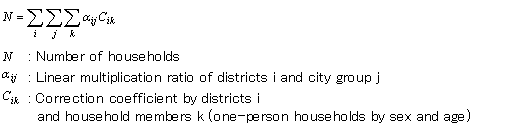
The expenditure of monthly average

8 Notes
The survey is undertaken as a collection of statistical reports in compliance with the Statistical Reports Coordination Law (Law No. 148, 1952) since 2002.
The revelation of the survey details to others as well as the utilization of the questionnaires by the enumerators and survey personnel for non-statistical purposes are strictly prohibited by the law (Statistics Law).
The collected questionnaires are placed in strict custody and burned up after the statistics are prepared.

