
Main contents start here
Q&A about the Consumer Price Index (Answers)
[A. About the consumer price index (CPI)]
A-1 What is CPI all about?
The CPI is meant to indicate average fluctuations in prices of commodities (goods and services) purchased by households nationwide. In other words, using the consumption patterns of households at a given time as the base period, the index shows changes in the total amount of expenditure required to purchase the equivalent goods and services purchased by households in the base period.
Thus, the CPI is intended to measure changes in prices themselves. We should note, therefore, that the index does not take into consideration fluctuations in living expenses caused by changes in the kind, quality, and/or quantity of commodities purchased by a household as its lifestyle, tastes, etc., change.
A-2 Since when has the CPI been calculated?
The CPI was launched in 1946 right after the World War II to be used for measuring the postwar rampant inflation. Since 1952, it has been calculated based on retail prices obtained from the Retail Price Survey (RPS).
A-3 What is the index reference period? And what is the weight reference period?
The CPI is calculated by comparing prices of comparison period from those of reference period in which the index is given a value of 100. The period for which the index is set to 100 is called the "index reference period".
The CPI is calculated as the weighted arithmetic means with the consumption pattern in the reference period (a rate of consumption expenditure by item) (See B-1). The year referenced for the weighted arithmetic mean is called the "weight reference period".
With regard to the official series of Japan's CPI data published monthly, both the "index reference period" and the "weight reference period" are the calendar year 2025 at present, which we call the "base year".
Base year is the year whose last digit is 0 or 5, and it is revised every 5 years ("base revision"). The items adopted for index calculation and other matters are also reconsidered at every base revision (See D-1).
A-4 How is the CPI used?
Prices tend to inflate as the economy becomes more active and the demand increases, while we usually come down as the economy grows sluggish and the demand diminishes. The CPI, which shows price fluctuations, is often called "a thermometer of the economy", and a crucial index as the government tries to make effective and appropriate economic policies. In addition, the index is used as a "deflator" for some other important economic indices, such as household consumption expenditure calculated from Family Income and Expenditure Survey (FIES), GDP statistics, and the like. Furthermore, the relevant laws require that the actual standards of the National ("Kokumin Nenkin") and Employee ("Kosei Nenkin") Pension payments should be adjusted in accordance with price fluctuations. Such fluctuations are measured in terms of CPI. Furthermore, Bank of Japan considers this index as valuable information for making financial policies. People look to the index when we determine wages, house rents, public utilities charges, etc. As you see, the index is broadly used both in the public and private sectors.
A-5 What indices do they use for measuring underlying inflation?
The index deducting the "Food (less alcoholic beverages) and energy" from the "All items" index is also calculated. A similar index is treated as important in the USA and some other nations.
The index "All items, less fresh food" index is often called "Core" index. And they also call "Core-core" index or so on for the indices excluding fresh food, energy or other various items. Please confirm the coverage of those indices when you use them.
(For your reference)
| Type of index | All items, less fresh food | All items, less fresh food and energy | All items, less food (less alcoholic beverages) and energy |
|---|---|---|---|
| Items excluded | Fresh food | Fresh food | Food (less alcoholic beverages) * |
| Electricity Gas, manufactured & piped Liquefied propane Kerosene Gasoline |
Electricity Gas, manufactured & piped Liquefied propane Kerosene Gasoline |
||
| Coverage, where the "All items" is 10000 | 9621 | 8872 | 6609 |
Note: * The food items excluded from the "all items" are all foods (less alcoholic beverages) including cakes & candies, rice, fresh food and hen eggs, and so on.
[B. Calculation of the CPI]
B-1 How do you calculate the CPI?
To calculate the CPI, we first choose items (goods and services) that occupy relative importance in household consumption expenditure. Next, based on the rate in the household consumption expenditure of these respective selected items, we determine the weights of each of these items. These shares are based on the results from the FIES and other surveys.
The prices of the selected items are mainly obtained from the monthly RPS.
Now, to calculate the CPI, we calculate the price index of each of the selected items, using its average price* for each surveyed municipality, with the index in the base year set at 100. Next, averaging each item's index with the weights (its share in the whole household consumption expenditure) determined above, we calculate group indices, such as those of Subgroups, of Ten Major Groups, the General (All items) price index, and so on.
At present, the base year for CPI calculation is 2025. This base year is updated every 5 years ("base revision") (See D-1).
At every base revision, the items and their respective weights are reconsidered. In 2025-Base CPI, the number of items totals 589. In case that new goods or services spread rapidly in our life, we consider a revision of items before the next base revision (See E-1).
*Some items such as "Electricity" and "Telephone charges (mobile phone)" have various fare structures, with prices that vary according to the purchased conditions. To suitably reflect the price fluctuation in the price index, monthly indices for these items are calculated with special formulas ("model formulas") which are designed by using a typical utilization case of each item as a model as well as prices surveyed by the RPS.
B-2 Is the CPI calculation method of Japan as same as that of major countries?
For CPI, the International Labour Organization (ILO) has set up an international standard. The 17th International Conference of Labour Statistics convened in Geneva in December 2003, adopted a resolution that set up the current standard. Concurrently, a revised international manual for CPI, entitled "Consumer Price Index Manual: Concepts and Methods" and "Consumer Price Index Manual: Theory" were completed and published on the IMF's website as well.
As with other major countries, Japan's relevant authorities basically follow the existing international standard and the manual as we calculate the CPI.
B-3 How do you select items used in calculation of the CPI?
The number of items selected for the calculation of CPI is 589. Items are selected in consideration of the relative importance of each item to the total household consumption expenditures. The numerous kinds of commodities (goods and services) purchased by households are sorted out by the similarities in their function, price trends and so on. Then they are classified into each item.
Every single item contains several commodities of which the specifications such as qualities, standards, volumes, etc. are different. To calculate the CPI, we specify the characteristics of items as "basic specifications", and its monthly prices are collected. (In conducting the RPS, a price collector picks up one of nominated products which sells the best at each store surveyed, and its price surveyed continuously.)
We reconsider the survey items in every-five-year revision based on the latest results from the FIES. In the 2025-base revision, new items such as "Spice", "Gummies" and "Helmets" added to the survey items (See D-1).
Furthermore, reconsideration of the survey items is to be made as appropriate during the period between the revision of the base and the next revision as well, as we expect some new goods and services will emerge and enter the market in the future (See E-1).
B-4 How do you calculate the CPI for clothes and other commodities whose distribution and sales differ considerably from one season to another? You seem to survey the prices of summer and winter clothes when they come on the market seasonally. Yet how do you calculate the CPIs for those months not directly covered by the survey?
With these commodities that do not appear at all or very few on the market during some period in a year, the RPS surveys their prices only during those months when each of them is distributed and sold. This naturally means that such commodities are not covered by the survey in some months (uncovered months). Now, in such months, the weights of those uncovered seasonal commodities are proportionately distributed to the other commodities covered by the survey. Yet this results in the average weight of the same item in some months differing from its annual average weight. To avoid this problem, for seasonal items such as clothes, the average index in the last survey period is applied in non-surveyed months to carry them forward to the month before the next survey.
B-5 What is imputed rent of an owner-occupied house?
Needless to say, buying a house or a piece of land is a form of property acquisition and not consumption expenditure. Such a purchase, therefore, is not counted in the CPI. Still, it is an undeniable fact that a household living in a house it owns receives some service from the house. Here, it leads to an issue that, one way or another, the housing expense of an owner-occupied house should be counted in the CPI calculation.
So, let us suppose a case where a house-owning household is renting the same house from someone else. Then, the household has to pay some rent, needless to say. Then, we can estimate the value of the service from an owned house which is equivalent to the worth of the service from a rent house and treat the value as housing expense. An "imputed rent of an owner-occupied house" refers to the rent paid to owner-occupied houses assuming that owned houses were rented. Such imputed rents are taken into the CPI calculation.
To include imputed rents, we determine the calculation weight of each and every type (size and structure) of house, depending on the imputed rent estimated by the Ministry of Internal Affairs and Communications in its "National Survey of Family Income, Consumption and Wealth." Then, we use the fluctuations in rents of "House rent, private" by RPS, to estimate changes in the imputed rents of owner-occupied houses of all the various types.
Note that this method of calculating imputed rents is employed by many major countries in their consumer price indices as well as in the System of National Accounts (SNA).
[C. Uses of the results]
C-1 When are results published?
The index figures of the preceding month for Japan are released at 8:30 A.M. (Japan time) on Friday of the week including the 19th of each month. The preliminary figures of the current month for the Ku-area of Tokyo are released at 8:30 A.M. (Japan time) on Friday of the week including the 26th of each month. The average index figures for the calendar year and fiscal year are released when the monthly figures for December and March are released respectively.
C-2 Do you publish a seasonally-adjusted CPI?
With the CPI and other monthly statistics, some commodity prices rise and fall after a similar pattern every year. For instance, many seasonal clothes' prices hike early in their season and fall later, around the end of the season, at sales. Price fluctuations of this kind are known as "seasonal variations".
We publish seasonally adjusted indices, less these seasonal changes for the 5 series: "All items", "All items, less fresh food", "All items, less fresh food and energy", "Goods" and "Services" for Japan and Ku-area of Tokyo. For the chained index for Japan, figures are published for the following 3 series: "All items", "All items, less fresh food" and "All items, less fresh food and energy."
Since the seasonally adjusted index is adjusted based on average seasonal changes calculated by past indices, price changes in particular months may affect other months (e.g., school fees, medical treatment). Thus, the seasonally adjusted index may change even in the months when no price changes actually occur.
At the same time, change over the year, comparison of the current index with that of the same month in the previous year is also useful to eliminate the seasonality. The rate of change over the year does not change for one year as long as prices do not change. Thus, in the CPI, change over the year is often used to see the price trends.
As for fresh food for which prices fluctuate greatly, and electricity and gas for which prices are changed by the revision, change from the previous month seems to be close to the real feeling of consumers. Thus, change from the previous month without seasonal adjustment is also published.
[D. Revisions to the bases]
D-1 Why is the CPI revised?
The CPI shows how much the average prices of commodities (goods and services) have changed since the base period. The consumption structure changes over time along with appearance of new commodities (goods and services) on the market or changes in consumers' tastes. For this reason, if the base period were fixed for an extended period, the index would not reflect actual conditions. Therefore, we revise the base period (base revision) regularly, reconsidering the items employed in calculating CPI and their weights, etc. In the case of the Japan's CPI, the base period is revised every 5 years, in the years with 0 or 5 in the last digit. From a global perspective, many nations revise their CPI every 5 years or so. In Japan, the Statistical Committee said in its report in 2010 that revisions every 5 years were appropriate for the CPI as well as other economic indices, and the standards of most economic indices are updated every 5 years, including price indices such as the Corporate Goods Price Index (CGPI), as well as quantity indices like the Index of Industrial Production.
From August 2026, 2025-base CPI has been published. (Main points of the 2025-base revision)
D-2 Isn't the CPI's base revision interval of five years too long to cope with rapid changes in the consumption pattern?
Actually, two types of the CPI are published. One is the "official" one, whose calculation weights are based on the shares of the FIES and updated every 5 years. The other is Laspeyres' chain index, whose weights are updated every year. This chain index is published in order to measure effects of changes in the consumption pattern more frequently (See H-1).
D-3 At the base revision of the CPI, how do you link old indices and new indices?
Since we change the items and update the calculation weights at the base revisions, the CPI before and after the revision are two different things, to be exact. In order to facilitate time-series analysis of price trends and changes over a long period of time, however, we do some processing to link old and new CPI, at every revision.
To do so, we calculate new-base linked indices by converting old-base CPI into new-base CPI; i.e. by dividing an old-base index by the ratio of the old-base yearly average index of the new base year to the new-base yearly average index of the new base year (new-base CPI = 100). This adjustment is applied to each and every article of calculation independently and the upper level indices are not recalculated by the linked indices. Also, the rates of change (from the previous month, over the year, from the previous year and from the previous fiscal year) are not recalculated by linked indices and figures published in each base-period are used as they are. In each base year, the figures calculated with the old-base are also used as they are, for the change from the previous month in January, the change over the year from January to December, the change from the previous year, and the change from the previous fiscal year.
D-4 What kind of impacts does the base revision have upon year-on-year percentage changes and contributions to the total change of the CPI?
The base revisions make differences in CPI inflation rates and the contributions to the total change of the CPI between the new and old bases. Those differences can be decomposed into "impact of weight change", "impact of index reset" and the other factors.
(Impact of Weight Change)
"Impact of weight change" occurred by the revision of the weight.
When the weight of an item in the new base becomes smaller than that in the old base, the absolute value of the contribution becomes smaller, too. When the weight becomes larger, the absolute value of the contribution also becomes larger.
The positive/negative signs of the contribution differences between new and old bases by impact of weight change are as follows:
Table Contribution differences between new and old bases (Impact of weight change)
| Weight differences | Year-on-year percentage changes (old base) |
Contribution differences |
|---|---|---|
| New weight < Old weight | Positive | Contribution in new base < Contribution in old base |
| Negative | Contribution in new base > Contribution in old base |
|
| New weight > Old weight | Positive | Contribution in new base > Contribution in old base |
| Negative | Contribution in new base < Contribution in old base |
(Impact of Index Reset)
"Impact of index reset" is occurred by the revision of the index reference period.
When the index in the new base is lower than that in the old base, the absolute value of the contribution tends to become smaller. When the index value becomes higher, the absolute value of the contribution tends to become larger.
The positive/negative signs of the contribution differences between new and old bases by impact of index reset are as follows:
Table Contribution differences between new and old bases (Impact of index reset)
| The previous-year-index differences |
Year-on-year percentage changes (old base) |
Contribution differences |
|---|---|---|
| New index < Old index | Positive | Contribution in new base < Contribution in old base |
| Negative | Contribution in new base > Contribution in old base |
|
| New index > Old index | Positive | Contribution in new base > Contribution in old base |
| Negative | Contribution in new base < Contribution in old base |
(The other factors)
There are other factors such as revision for calculation methods of model items, adding/removing of index items, etc.
[Reference] Decomposition of contribution difference between the new and old bases (PDF:173KB)
D-5 How much impact did the 2025-base revision have on year-on-year percentage changes?
As an example, the year-on-year percentage change of all items index for Japan in June 2026 in new base was revised downward by 0.1% points than that in old base. The impacts of base revision on year-on-year percentage change were as follows. Please note that the impacts differ from month to month.
| Impact of weight change | 0.10 |
| Impact of index reset | -0.15 |
| Impact of revision for calculation models | 0.00 |
| Impact of adding/removing items | 0.02 |
| Total (contribution* difference between 2025-base and 2020-base) | -0.03 |
For the detail, please refer to "Retroactive results for 2025-base Consumer Price Index (PDF:84KB)".
D-6 What are the differences in year-on-year percentage changes between the 2025-base revision and the previous base revisions?
There are some factors that cause differences in year-on-year percentage changes between the new and old base (See D-4). In the 2020-base revision, the absolute value of the impact of revision for calculation models was 0.24 at its peak, whereas in the 2025 base-revision, the absolute value of the impact of index reset is the largest at 0.15.
| Difference between new and old base* | Impact of weight change | Impact of index reset | Impact of revision for calculation models | Impact of adding/removing items | |
|---|---|---|---|---|---|
| June 2011 (2010-base revision) |
-0.7 | -0.20 | -0.19 | -0.24 | -0.01 |
| June 2026 (2025-base revision) |
-0.1 | -0.10 | -0.15 | 0.00 | 0.02 |
For more details, please refer to "Retroactive results for 2025-base Consumer Price Index (PDF: 84KB)"
[E. Midpoint-year review]
E-1 What is a midpoint-year review?
CPI items shall be revised every 5 years (base revision) in order to reflect the changes of consumption pattern. However, when there is a rapid influx of new products or a radical change in consumption pattern, the items are reviewed in a midpoint year during the 5-year period before the next revision year (midpoint-year review).
Based on the 2020-base, after reviewing whether it was necessary to add new items or make other changes, we decided not to revise the list of items. However, regarding the COICOP classification indices*, to enhance international comparability, we have decided to publish monthly results in addition to the annual average. For details, please refer to the call for comments on the "Review (Draft) of the 2020-base Consumer Price Index for the midpoint-year (2023)."
*Index items have been reorganized in accordance with the United Nations' international classification standard, "Classification of Individual Consumption by Purpose (2018)" (COICOP 2018). COICOP stands for Classification of Individual Consumption According to Purpose.
Midpoint-year reviews have been conducted since the 2000-base. The following are the reviews conducted in the past.
- Midpoint-year review of the 2000-base (effective in January 2003)
| Added items |
| PC printers Internet connection charges |
* For the item "Cameras", the prices of digital cameras were also incorporated in the index.
- Midpoint-year review of the 2005-base (effective in January 2008)
| Added items | Consolidated items |
| Beer-flavored alcoholic beverages Washing & Drying machines TV games (portable) |
TV sets (CRT) Media for audio recording |
* For the item "Telephone charges", the prices of charges for IP phones were also incorporated in the index.
Midpoint-year review of the 2010-base
- Effective in January 2013
"Celler phones" and "Mobile telephone charges" incorporated the prices for smartphones. - Effective in January 2014
"Personal Computers (laptops)" incorporated the prices for tablet computers.
Midpoint-year review of the 2015-base (effective in January 2018)
[F. Quality adjustment]
F-1 What is quality adjustment with CPI for, and how do you make it?
The CPI, since it is meant to purely measure changes in prices, should basically continue to track down the prices of the same products (goods and services). On the other hand, it is needed to update the survey specifications list as the changes of well-selling products depending on retailer's sales strategies and consumption behaviors. In such update, the differences in functions, qualities such as characteristics, etc., and volume between the old and the new can alter the price index. Now, the "quality adjustment" is applied to eliminate the influence of such differences. Thus, quality difference from old products to new products is measured quantitatively by the quality adjustment during calculation of the CPI.
With the CPI, whenever products to survey are updated, we have quality adjustment, choosing the best method from several such as the overlap method, adjustment by the ratio of quantity, adjustment by the regression equation, the option cost method, the class mean imputation method, the direct comparison method, and others. For TV sets, PCs and cameras, whose quality improvement is very rapid and product cycles are quite short, the hedonic method with some information from POS systems is employed to directly calculate price changes after quality adjustment (See F-2).
(POS information data) This information contains each product's sale price(s) and volume, as well as its characteristics, and is collected from retailer's POS (Point Of Sales) systems. The CPI calculation employs POS information data on product-by-product sales prices, volumes, and characteristics for all the TV sets, PCs, cameras, etc., sold in major mass retailers in our country.
F-2 What is the hedonic method?
The hedonic method, one of the methods used in quality adjustment, stands on the supposition that the quality of a product can be broken down to several characteristics (performance) that make up the quality, and that the product's price is determined by the performance. The method uses multiple regression analysis to identify the relationship between each product's price and its characteristics (for instance, in the case of a PC, its memory capacity, the CPU memory capacity, the display size, etc.) This way, the method quantitatively determines to what degree the product quality accounts for price differences among different products.
The CPI calculation employs this hedonic method to directly calculate price changes after quality adjustment of TV sets, PCs and cameras, whose technological improvement is very rapid and product cycles are quite short. Since this method requires a huge amount of data on prices, volumes, and characteristics of numerous products in order to provide a reliable and objective multiple regression analysis, we use POS information data with the hedonic method.
F-3 I heard that, with the hedonic method, the price of an item is considered to be gone half off if its performance has doubled. Is this true?
In the hedonic method, the relationship between the price and the characteristics (performance) of a product is calculated statistically, using a huge volume of sales data (POS information data) collected from major electric appliance stores. Therefore, in light of the results of calculation to examine how each element of the performance of a product affects its price, the price of a product cannot be considered to be gone half off even if its performance has doubled.
For example, suppose that a relationship where "the price of personal computers rises by 5.0% when the memory capacity increases by 1 TB" has been estimated. Based on this, "when a new PC model whose memory capacity has increased by 1 TB is released, the price of the PC is reduced by 5.0% for comparison of the new and old PCs" (see the illustration below). Thus, the term 'performance' itself requires careful definition, and there is no simple way of determining quality adjustment for performance improvement.
[An example of the quality adjustment with the hedonic method (personal computers)]
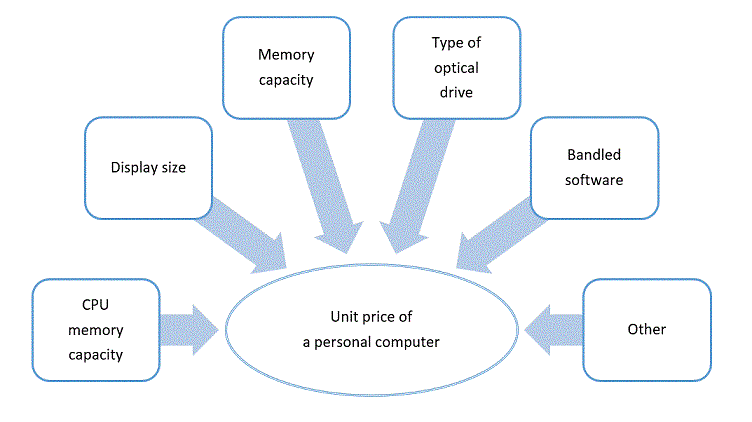
-> The correlation between the characteristics and the prices of personal computers is analyzed based on huge volume of sales data for personal computers.
-> The correlation whereby -> a 1 TB increase in memory capacity will result in a 5.0% rise in the prices of personal computers, is estimated.
-> When new personal computers with 1 TB larger memory capacity appear, their prices are to be reduced by 5.0% for price comparison.
[For your reference]
The actual calculation employs a statistical regression formula:
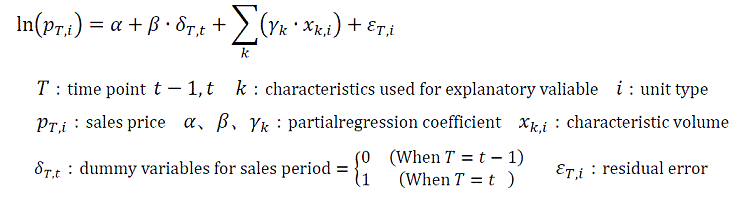
[G. Frequently asked questions about the CPI]
G-1 One new product after another shows up on the market. Does the CPI survey reflect prices changes of these new products?
Concerning the survey specifications, we investigate the distribution and sales of the major specifications of each and every item and, if we find any existing survey specification declining in distribution, we switch to another specification that is selling more. In addition, we try to cover new products in the survey on a timely basis. For instance, in case a manufacturer abolishes the production of a survey specification and launches a new, follow-up product, we change the survey specification in response. Thus, we always keenly follow prices of specifications that truly represent the items.
* For information on what items are surveyed in the Retail Price Survey, please refer "Survey Items and Specifications for the Retail Price Survey".
G-2 Are private brand commodities surveyed?
Some Private brand (PB) commodities that conform to the prescribed basic specifications (product characteristics and other factors established to enable comparison of items of the same quality) and sell the best at each outlet are basically subject to the survey, and the prices are used for calculating the CPI. For example, as to many items (about 70%) of groceries such as milk, white bread, edible oil, fruit juice, etc., PB commodities conforms to the specifications and are subject to the survey.
PB commodities: Those for which leading supermarkets or similar outlets independently plan, develop and establish their own brands for sale.
G-3 Are discount stores included as survey subjects?
In the RPS which collects the price data for the CPI, we choose representative retail stores that have greater sales volumes for each item in each survey district and investigate the retail prices of these stores. Therefore, if the discount store in a survey district is considered to be a representative retail stores that has greater sales volumes, it will be included in the survey.
[For your reference]
Q&A about the Retail Price Survey
G-4 Will the CPI appropriately reflect the change of quality such as functional improvement of products?
The objective of the CPI is to measure the pure price movements which shall not include the influence of quality changes. Therefore, we remove price differences caused by quality changes in case where old products surveyed can be replaced by new products, etc., taking into account the differences in functions, characteristics, and volume (See F-1).
G-5 It is said that there is an upward bias in Japan's CPI. Is this true?
It is pointed out that the upward bias in the CPI can be caused like when the item with a big price fall shows 1) the increase of relative amount of the expenditure ratio with the expansion of demand, or 2) the remarkable decline of its price index as the time passes. Therefore, we release the reference index calculated by the Laspeyres' chain index method as well as the fixed base Laspeyres index. The chain index is compiled with weights updated every year and "resets" its index reference period as the previous December, though the fixed base index is updated both the weights reference period and the index reference period every 5 years.
When comparing change from the previous year of the "index for all items, less fresh food" between the fixed base Laspeyres index and the index calculated by Laspeyres' chain index method from 2012, the difference has been small. It suggests that the relative expenditure ratios of items with fall in prices do not always expand, and the "reset" effect became smaller because the continuous price down, typically shown on durable goods before, have been disappeared in this period.
G-6 I heard that Japan has adopted a different method for selecting products subject to the RPS from that of the United States. Is Japan's selection method different from other countries?
The international standards for calculation of the CPI, which were established by the International Labour Organization (ILO), stipulate that the CPI aims to measure chronological changes of prices, and shall be calculated by measuring the cost of purchasing a fixed basket of goods and services of the same quality and attributes. In line with this basic concept, the international standards specifically define that, for each item surveyed, its detailed description such as the quality and attributes should be specified so that prices of the same quality should be surveyed continuously. In Japan, surveys have been conducted in accordance with these standards as in Canada and major European countries, including the UK (See B-2).
In addition, Japan has reviewed the survey specifications according to changes of an influx of products to ensure that prices of the most representative products which sell the best are surveyed consistently.
Thus, in Japan, the RPS has been conducted by paying close attention to detail in accordance with international standards.
Although the CPI is calculated almost entirely based on the international standards in the United States, the survey specifications in accordance with the international standards are not defined in advance. Instead, a unique method that allows enumerators to pick out items according to distribution of products for each shop and survey their prices, is adopted. In this method, products picked out vary according to shops, and they may include those which are classified as the same item but do not have the same quality. As a result, it is likely that there will be large fluctuations in prices within each item.
G-7 Is there anything I should note when I compare the CPI and Corporate Goods Price Index (CGPI) published by Bank of Japan?
The CPI includes service items such as school fees, rent, eating out, etc., which account for almost 50% on the calculation weights basis though the CGPI does not include service items. Prices of services tend to fluctuate less than those of goods, since labor costs account for more service prices than prices of goods.
Also, the CPI covers goods purchased by households and does not include crude oil and other raw materials, intermediate materials like electric components, construction machinery and other types of equipment, etc. Thus, a price hike in these goods affects the CPI only indirectly.
For these reasons, the CPI and the CGPI do not necessarily show similar changes.
For your information, when the scopes of the two indices are narrowed down to cover the same items as far as possible, i.e., when we compare the CPI for "Goods, less fresh food" with the domestic CGPI for "Final consumer goods" alone, the two indices show similar fluctuations.
G-8 I hear that the CPI and the GDP deflator (Published by the Cabinet Office) are different from each other. Why is this?
Compared with the recent movement of the CPI and that of the GDP deflator, the change ratio of the GDP deflator has been lower than that of the CPI. The discrepancy between the CPI and the GDP deflator is mainly ascribable to the different things they cover. Other causes of the discrepancy include the different calculation formulae employed.
(1) The Target
While the CPI focuses only on household consumption, the GDP deflator covers business investments in equipment, etc., in addition to household consumption. Since much of the investment in equipment today is made in information technology goods, whose quality is rapidly improving, price falls in such goods considerably affect the deflator. For this reason, the change ratios of the deflator tend to be lower than those of the CPI.
Also, while the prices of petroleum products and other imported goods are rising/falling, the CPI is usually pulled up/pushed down. On the other hand, the deflator tends to drop/hike until such price hikes/drops are all reflected in the relevant product prices. Thus, the discrepancy between the two grows wider.
If the scopes of the two indices are narrowed down to cover the same items as far as possible, i.e., if we compare the CPI for "All items" with the GDP deflator for "Final household consumption expenditure" alone, the two indices show quite similar fluctuations.
(2) The Formula
While the CPI calculation employs the Laspeyres formula, the GDP deflator employs the Paasche formula. Generally, the Paasche formula, which calculates a weighted average using the quantitative weights at the time of comparison, tends to provide a lower index, while the Laspeyres formula, which employs quantitative weights at reference period, usually produces higher values. In addition, since quality improvement is reflected in the form of an increase in volume, Paasche formula gives a larger weight to an item whose price has fallen due to quality improvement. For this reason, the rate of decline of the GDP deflator, which employs Paasche formula, tends to be getting larger.
Also note that the GDP deflator employs a "chain method" updating weights annually, to minimize the bias accompanying calculation of the index. Such a chain method is also used with the CPI as well, to provide and publish a referential value to the index (See H-1).
G-9 Recently, there have been instances in some media reports where price indices based on POS data are compared with the Consumer Price Index (CPI). What points should one keep in mind when reviewing such comparisons?
Recently, thanks to advances in data utilization and processing technologies, the private sector has also begun attempting to create indices based on POS data. When using such indices, it is important to pay attention to the following points: (1) whether there is any bias toward specific items or stores; (2) whether prices drop when new products are introduced; (3) whether changes in product volume are being ignored; and (4) whether adjustments have been made for quality differences between old and new products (the Consumer Price Index measures price fluctuations and differs from a unit price index, which incorporates changes in quantity and quality).
The Consumer Price Index surveys prices at representative stores nationwide for a broad range of items - including services, which account for a large portion of household consumption - that cannot be obtained from POS information data. It takes appropriate measures regarding the introduction of new products, changes in product volume, and quality adjustments between old and new products. Furthermore, for televisions, personal computers, and cameras, quality-adjusted price indices are compiled using POS data and the hedonic method. In addition, for video recorders, tablet computers, printers, memory cards, and ink cartridge for printers, where price differences between old and new products are small and can be explained by a limited number of characteristics, indices are compiled using the fixed-specification method (See G-11).
G-10 Sometimes new products are released that have the same price but offer a smaller quantity or are lighter in weight. Are these so-called "hidden price increases" reflected in the Consumer Price Index?
In the Consumer Price Index, when a product (brand) being surveyed is discontinued and a successor product is released, the index switches to a widely available product to ensure the new product is incorporated promptly (See G-1). In such cases, if there is no change in the quality of the surveyed brand and only the quantity or weight has decreased (or increased), that difference is evaluated as a real price increase (or decrease) and reflected in the Consumer Price Index.
For example, in the case of jam, where the price remains unchanged, but the weight is reduced from 165g to 150g - effectively a price increase - the index reflects this impact by multiplying the price of the newly surveyed 150g product by the weight ratio (165/150).
Furthermore, for food items such as potato chips and orange juice, as well as products like laundry detergent, prices are surveyed per unit of weight or quantity (e.g., 100g or 1,000mL); therefore, real price changes resulting from changes in weight or quantity are reflected in the index as they occur.
G-11 What is the fixed specifications method?
The fixed specification method uses the characteristic information of each model from the POS information data (scanner data), and only products which have certain fixed specifications - for example, tablet computers which have a storage capacity of 128 to 256 GB and a display size of 10.5 to 12.0 inch - are selected from the POS information data. By the method, quality of the products becomes constant. The fixed specification method is similar to "detailed specifications" in Retail Price Survey, but fixed specification method leads the price movement more stable than detailed specifications, because more models are likely to be selected than detailed specifications. When changing a trademark due to the introduction of a new product such as a successor model, if it matches the selected specifications, it can be extracted from the month of release. The fixed specification method is simpler and easier to calculate than hedonic method.
In the CPI, the fixed specification method is used to make indices of "Video recorders", "Tablet computers", "Printers", "Memory cards" and "Ink cartridges for printer", which have less difference between old and new products, and whose price can be explained with few characteristics.
[An example of model extraction by fixed specification method(tablet computers)]
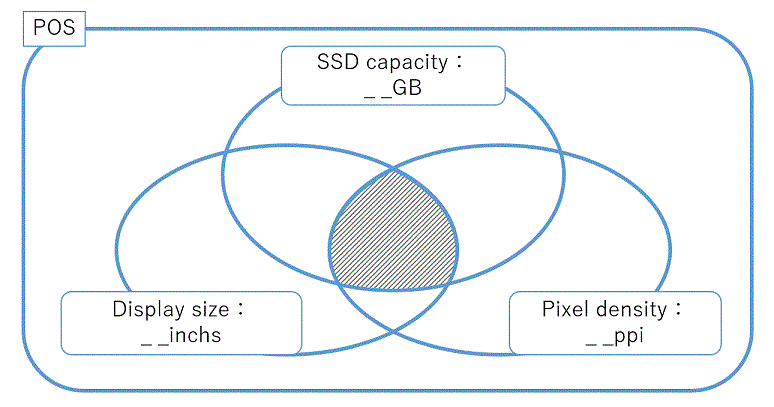
-> Characteristics that correlate with the price of tablet computers, such as SSD capacity and display size, are selected.
-> The main specifications for each characteristic are selected.
-> With fixing the selected specifications, models that match the specifications from the monthly POS information data are extracted.
[H. Consumer Price Index calculated by Laspeyres' chain index method]
H-1 What kind of index is "Consumer Price Index calculated by Laspeyres' chain index method" compiled as one of the supplementary indices?
We publish the CPI that the fixed base Laspeyres formula is applied to and the reference period and weights have been fixed for 5 years as basic classification indices.
On the other hand, "Consumer Price Index calculated by Laspeyres' chain index method" (hereinafter referred to as "chain index") is the index which is calculated with weights annually updated instead of fixed to the reference period so as to reflect changes in the consumption pattern more rapidly.
H-2 How is the chain index calculated?
The chain index is calculated with the weights annually updated. We calculate the chain index as follows (an example of June 2026):
(1) We calculate the link index in June 2026 with "the latest weights" (the weights in the previous year). That is, the link index in June 2026 calculated by weighted averaging the ratio of the prices in June 2026 to the prices in December 2025 with the weights in 2025.
(2) We calculate the chain index in June 2026 by multiplying the chain index in December 2025 by the link index in June 2026.
H-3 What is the difference in the rate of change between the chain index and the fixed base Laspeyres index?
In general, the chain index tends to rise to a smaller extent when the rate of change is positive, and it tends to fall to a larger extent when the rate of change is negative than the fixed base index.
For instance, when the item with a big price fall shows the increase of relative amount of the expenditure ratio with the expansion of demand, the change rate of the chain index declines greater than the fixed base index because of the weights of chain index are updated every year though the weights of fixed base index updated every 5 years. In addition, the chain index is calculated by multiplying the link indices based on December of the year before, therefore resetting the index to 100 also affects the rate of change.
H-4 Why do you position the chain index as a supplementary index?
It is said that a phenomenon called "drift", the index could be high, may occur in the chain index when the prices of some items repeat ups and downs. In the case of the chain index, the weighted averages of indices of lower-level groups or items do not match those of the corresponding upper-level groups (the chain index has no additivity).
Therefore, we publish the chain index as the reference index. In addition, the chain index is published on the same day as the indices of basic classification every month, so that either index is available.
[I. Consumer Tax]
I-1 Does the CPI include the Consumer Tax?
The objective of the CPI is to measure the movements in prices of goods and services purchased by households. Therefore, the CPI reflects what consumers actually pay, including the Consumer Tax.
The international standards for calculation of the CPI, which were established by the International Labour Organization (ILO), stipulate that the CPI contains indirect taxes, which include the Consumer Tax in Japan.
[Others]
1 If price data cannot be collected due to the impact of the COVID-19 pandemic, such as temporary store closures or temporary product shortages, how is the Consumer Price Index calculated?
The Consumer Price Index is calculated primarily using price data obtained from the Retail Price Survey. When price data cannot be obtained due to temporary store closures, product shortages, or other factors, the previous month's prices are used for items where monthly price fluctuations are small and market supply is expected to remain uninterrupted.
For items subject to seasonal price fluctuations, such as fresh food and certain clothing items, the relevant price data is excluded when calculating the index for those items.
*For information on the Retail Price Survey, please refer to the "Retail Price Survey (Trend Survey)."
2 Due to the COVID-19 pandemic, overseas package tours were suspended and resumed after 2020. Have you taken any measures regarding "Charges for package tours to overseas" index?
The "Charges for package tours to overseas" index faced difficulties in stable price collection due to the impact of the COVID-19 pandemic, which led to the cancellation of many tours. As a result, from the January 2021 results onwards, the index was supplemented by substituting the "Charges for package tours to overseas" index of the same month in 2020. Because stable price collection became possible again as foreign package tours gradually resumed and it was confirmed that the unique movements of the "Charges for package tours to overseas" index, such as price increases during the travel season, generally matched past trends even after the resumption of collection, the index was created using prices collected through web scraping as before from the January 2024 results onwards.
Therefore, the year-on-year comparison of the "Charges for package tours to overseas" index for 2024 includes changes during the supplementation period from 2021.



Some of the publications on this site are in PDF. To view them you will need to have Adobe Reader. Please click the graphic link to download Adobe Reader.